
17 Maret 2026
Lebih dari Sekadar Pipa dan Pompa: Eliza Bhakti Amelia Memperjuangkan Akses Air yang Adil Melalui Kebijakan
For Eliza Bhakti Amelia, access to clean water is more than pipes, pumps, and running taps. In a cou... Baca selengkapnya

Australia Awards adalah beasiswa dan studi singkat bergengsi yang bersifat transformatif, diberikan kepada para pemimpin masa depan untuk menempuh studi, penelitian, dan pengembangan profesional di Australia

11 Februari 2026
 Mengatasi Sindrom Penipu, Lilik Astari Berusaha Mengoptimalkan Potensi Bahan yang Dianggap Tidak Berharga
Lilik Astari understands that science can be a daunting career path for girls and women. She has drawn on her resilience and relationships with fellow researchers to build a career in an emerging environmental field.
Lilik was awarded an Australia Awards Scholarship in 2013 to pursue a Masters of Forest Ecosystem Science at The University of Melbourne. She then returned to the university in 2020 to study for a PhD under the same supervisor, Professor Barbara Ozarska, with whom she had remained in contact.
It took three attempts to secure the scholarship for her masters degree, but Lilik was determined to keep trying. She was attracted to study in Australia by the high-quality education and the supportive living environment for her family. Later, when her PhD research was affected by the COVID-19 pandemic, she needed to draw on her resilience even more.
‘Completing a PhD during the pandemic while bringing my family with me was one of the most challenging stages of both my academic and personal life. After going through that experience, I became much more resilient and better prepared to face future challenges,’ said Lilik, who is now a researcher at the Research Centre for Biomass and Bioproducts, National Research and Innovation Agency of Indonesia (BRIN).
Overcoming Impostor Syndrome
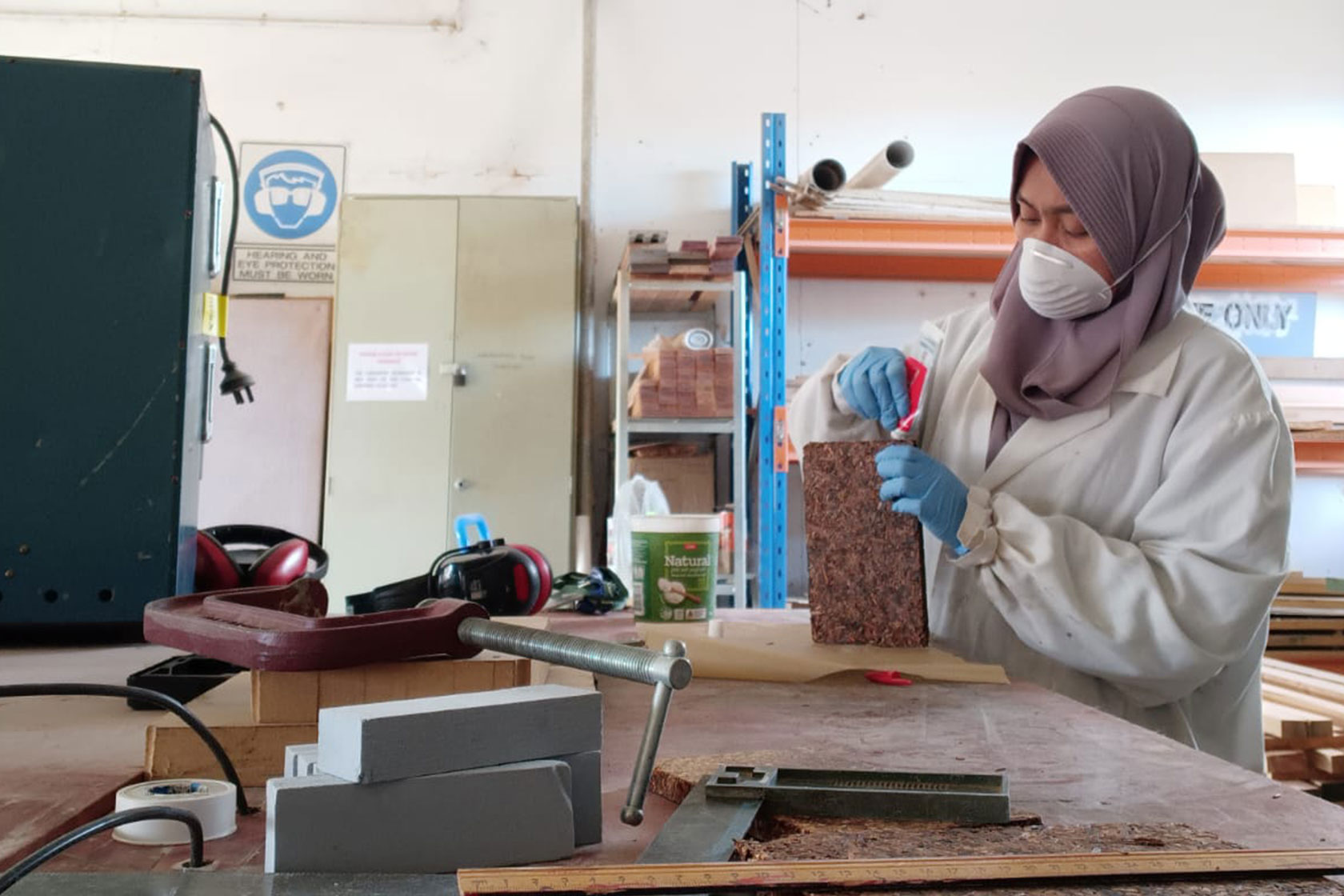
Lilik’s PhD research focused on developing a safer, more sustainable way to manufacture particleboard, which typically uses formaldehyde-based adhesives that can harm the environment. Her research explored the use of corn stalk, with citric acid as an adhesive. She admitted that at one point she experienced impostor syndrome, feeling that her research topic was too simple and insignificant.
’There were times when I doubted whether my research was worth pursuing. My supervisor reminded me that if I, as the lead researcher, lacked confidence, then how could others value the work I was doing? From there, I learnt to be more confident, to avoid insecurity and to persist in finding novelty and originality in my research,’ she explained.
’I also learned a great deal about endurance from my supervisor, how a researcher must not give up easily when facing challenges in research. The difficulties we encounter, whether in collecting or analysing data, should serve as motivation to understand why errors occur and how to solve them.’
Upon returning from Australia, Lilik discovered new levels of confidence. She had also developed valuable skills in project management, as the PhD gave her the opportunity to manage a complex project independently from start to finish.
Facilitating Research Partnerships
During her PhD, Lilik played an active role in fostering research collaboration between the Sustainable and Renewable Forest Products Group at The University of Melbourne and the Biomass and Bioproducts Research Group at BRIN. One such collaboration was a joint research project led by Dr Johannes Fehrmann, Maya Ismayati and Wahyu Dwianto, which resulted in the publication ‘Effect of Processing and Cultivar on Thermo-Chemical Properties of Australian-Grown Hemp Hurd (Cannabis sativa L.)’ in the Journal of Renewable Materials (Tech Science Press, 2024).[1]
It came about when Lilik learned that researchers from abroad could access BRIN’s research facilities without paying, as long as they collaborated with BRIN’s researchers. When Johannes Fehrmann, her lab mate at the time, became interested in using the equipment at BRIN, she made the introduction that eventually led to a collaboration.
After completing her studies, Lilik continued to foster collaborations, including one between researchers at BRIN, Universitas Sumatera Utara and The University of Melbourne, which examined fire-resistant properties in forestry products.
Ongoing International Collaboration
At the end of 2025, Lilik was working to establish another connection, this time between the Centre for Sustainable Bioproducts at Deakin University and the Biomass and Bioproducts Research Group at BRIN. In addition, Lilik herself has also continued working with her supervisors, Dr Benoit Belleville and Professor Ozarska. To date, they’ve published three journal articles together.[2]
Lilik’s most recent journal article is an adaptation of her PhD thesis, published in early September 2025. The article, ‘Life Cycle Analysis of Particleboard Made of Corn Stalk and Citric Acid at Laboratory Scale’, was published by the Multidisciplinary Digital Publishing Institute (MDPI) in Applied Sciences, Volume 15, Issue 17[3].
Imagining the Potential of Waste Materials
Lilik has now dedicated 16 years to researching how organic material, or biomass, might be used to make eco-friendly, alternative materials.
‘As a researcher focusing on biomass waste, one of the key lessons I’ve learnt is that what we often see as useless or without value may simply be unappreciated because we don’t yet know how to make use of it,’ Lilik reflected.
‘That’s why, as researchers, we have a responsibility to uncover the potential of what is initially considered worthless and then share with the public how it can be transformed into something valuable.’
On the International Day of Women and Girls in Science, Lilik encouraged younger women and girls who are considering careers in science to go for it. She advised them to invest time not only in their studies, but also in building connections.
‘Often, we perceive STEM as a difficult field. However, with persistence in learning and the belief that you are capable of understanding it, even complex topics and challenges can eventually be understood and solved,’ Lilik said.
‘The self-confidence I mentioned earlier also means being courageous in pursuing opportunities. This includes applying for scholarships, seeking admission to reputable universities, and reaching out directly to experts in your chosen STEM field to learn from them and build professional connections.’


[1] https://doi.org/10.32604/jrm.2024.053741
[2] https://www.sciencedirect.com/science/article/pii/S2589014X24000434
https://scholar.google.com/scholar?oi=bibs&cluster=3580116555865045100&btnI=1&hl=en
[3] https://www.mdpi.com/2076-3417/15/17/9705
Bagikan berita ini di:
Berita Terkait