
01 December 2025
Australian Alumni Gala Dinner Celebrates Outstanding Alumni Contributions
The Australian Alumni Gala Dinner on 20 November 2025 in Jakarta brought together hundreds of Indone... Read more

The Australia Awards are prestigious, transformational scholarships and short courses offered to emerging leaders for study, research and professional development in Australia
04 December 2025
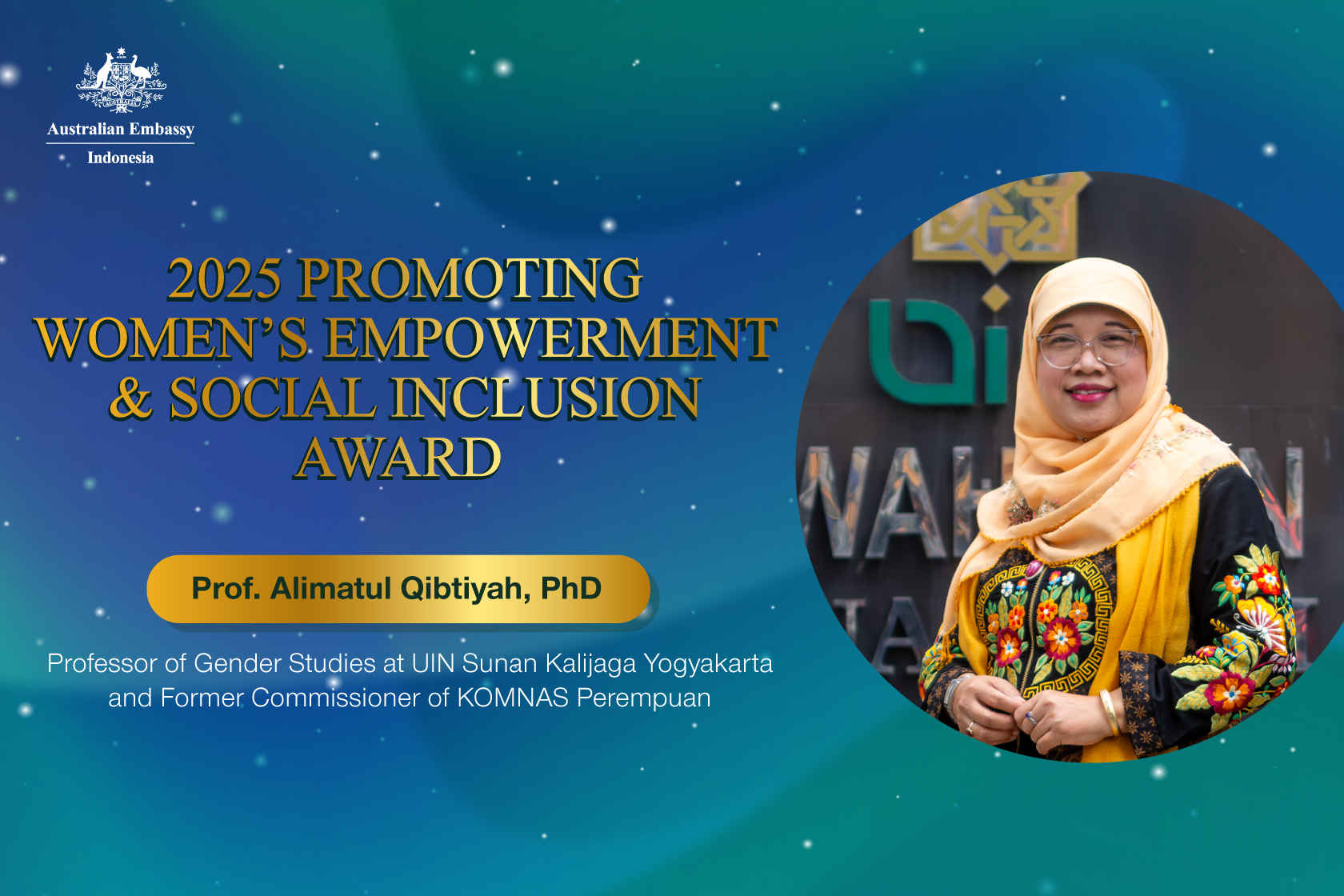
 Alimatul Qibtiyah: A Determined Campaigner for Gender Equality
Professor Alimatul Qibtiyah has been working at the intersection of gender and Islam for over three decades. In that time, she has made significant contributions to academia and policy, while sometimes facing heavy opposition.
Alim has been interested in gender issues since she started university in early 90s. Her masters thesis explored the attitudes of religious leaders in Yogyakarta.
She completed her masters degree at Universitas Gadjah Mada, and has been active at the Women's Study Centre at the Universitas Islam Negeri (UIN) Sunan Kalijaga Yogyakarta as well as in the central leadership of Aisyiyah, an autonomous women's organisation within Muhammadiyah.
Over the years, she has balanced her service to women’s groups with relentless learning. Among her long list of credentials is a PhD from Western Sydney University (2013) and an Australia Awards Short Course on Human Rights Leadership to Influence Policy (2021).
With her deep expertise in gender, she has held influential positions, including Director of the Women's Studies Centre at Universitas Islam Negeri (UIN) Sunan Kalijaga Yogyakarta (2013–2015), Chair of the Research and Development Institute of Aisyiyah Central Leadership (2015–2022), and Commissioner of the National Commission on Violence Againts Women (Komnas Perempuan) (2020–2024).
The Challenge for Women’s Rights
From the beginning, Alim knew her work on gender equality would come with great challenges. There are people within her religion who remain opposed to gender equality.
‘In the late 1990s, I was still experiencing situations where, when I talked about gender equality and justice, I was asked to repent and was accused of promoting Western ideas that were not Islamic. I was also accused of being part of a liberal, secular and non-religious group,’ said Alim.
Around that time, the women's movement in Indonesia began to grow. She often received intimidation and threats as she spoke out loudly for women's rights.
Today, the women’s movement in Indonesia is massive, and new layers of challenges have emerged. Alim said that some people use verses from the Quran with incorrect interpretations to act unjustly toward women. Instead of engaging with the broader context of the verses and the circumstances surrounding their revelation, some people focused primarily on surface meanings without exploring deeper layers of interpretation.
‘One of the ongoing challenges relates to patriarchal perspectives and the more conservative ways some Quranic verses are interpreted,’ Alim said.
Growing Expertise in Gender and Islam
In Australia, Alim pursued a PhD focusing on feminism and gender in Islam, which paved the way for her to become a professor in gender studies, a role she continues at UIN today. Her work has made significant contributions to Indonesia’s growing women’s rights movement.
A significant portion of her dissertation was published in Indonesian feminist books, titled ‘Feminisme Muslim di Indonesia, which are widely used by university students. She also developed a theoretical framework for understanding Muslim community thought across conservative, moderate and progressive perspectives.
Her PhD in Western Sydney, supported with a scholarship from Indonesia’s Directorate General of Higher Education, was not her first visit to Australia. In 2003, she had participated in the Australia-Indonesia Muslim Exchange Program (AIMEP).
She remembers the experience as the first international program where she saw firsthand that Australia has a vibrant Muslim community. She observed how Muslims live in the community with mutual respect and returned home hoping to apply what she had seen in Canberra’s interfaith tolerance policies.
Shaping Landmark Policy on Sexual Violence
One of Alim’s career milestones as Commissioner at Komnas Perempuan was pushing for the passage of a law on sexual violence (Tindak Pidana Kekerasan Seksual (TPKS).
‘It took nearly 20 years of struggle before it was finally passed in 2022,’ she said. Komnas Perempuan, together with civil society organisations in Indonesia, fought very hard for the passage of the TPKS Bill.
In addition, she was tasked with the issue of preventing and handling sexual violence on educational campuses. She helped shape the regulation on the Prevention and Handling of Sexual Violence in Higher Education, which was passed first.
‘I was invited by the Minister of Education to ensure that campuses had clear mechanisms in place when sexual violence occurred,’ said Alim. ‘I helped draft and refine this policy. After the regulation was issued, the Criminal Act on Sexual Violence followed a year later.’
The two regulations work in synergy to tackle sexual violence. A Task Force on Criminal Acts of Sexual Violence was also established on each campus to serve as a reporting centre for victims and witnesses of violence.
‘This is not only about sexual violence but also violence related to disability and other vulnerable groups. The scope of preventing and handling violence in higher education institutions is even broader,’ said Alim.
A Sister’s Memory Drives Alim’s Advocacy
There is a particular personal experience that has been a motivating force for Alim throughout her struggles for women’s rights. When Alim was pursuing another masters degree in the United States, one of her sisters passed away.
Alim comes from a family of nine children. In 2004, one of her older sisters registered to work in Brunei Darussalam to help support the family financially.
‘Her husband was a football player who sometimes earned money, sometimes didn't. When the family faced financial problems, it was often the women who had to find a way out by becoming domestic workers,’ said Alim.
When the administrative matters were completed, and all that remained was to wait for departure, Alim's sister became pregnant.
‘She had borrowed money from the bank to arrange her departure and had tried very hard to go, then she became extremely stressed and suffered a miscarriage,’ said Alim.
‘Due to her limited finances, she couldn’t access proper healthcare. She even resorted to drinking herbal remedies. Ultimately, she developed complications and passed away.’
This experience strengthened Alim’s resolve to continue advocating for women's rights in Indonesia.
Moving in the Direction of Women’s Rights
Through her various trips to Australia for various study opportunities, Alim has had the opportunity to follow developments in women’s rights in both countries.
‘In Australia, pregnant women and children receive payments from the government to guarantee their welfare. The mechanisms for protecting women are also very advanced,’ said Alim.
She believes Indonesia is moving in the same direction. However, what is most important now is to encourage the public and academics to monitor the implementation of existing policies.
‘From Australia, we can learn how to oversee the implementation of policies. We can even follow the process of developing modules and learning strategies,’ she said.
Her current role as one of the leaders of the Steering Committee of the GEDSI Australian Alumni Network is enhancing the capacity of alumni to make an impact on gender equality in Indonesia and strengthening bilateral relations through cooperation in the field of gender and inclusion.
With continued collaboration and the active contribution of alumni, Alim is confident that Indonesia can make meaningful progress in advancing women’s rights and creating a more inclusive future for all.
.jpg)
Share this news on:
Related News